Sacred Geometry – The Hidden Symbolism in Iraqi Mosque Architecture
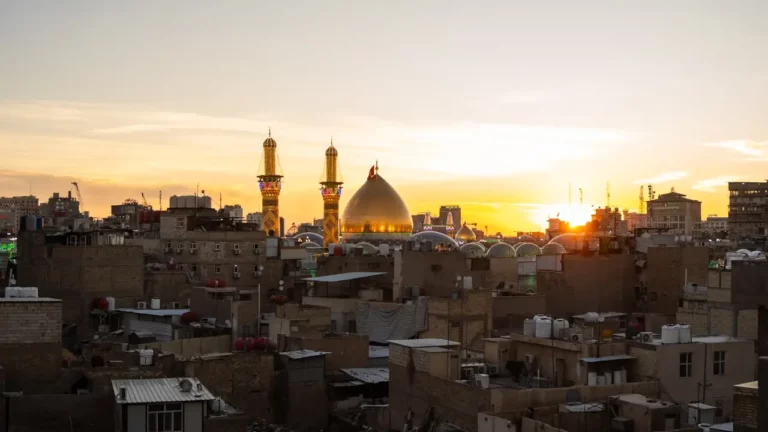
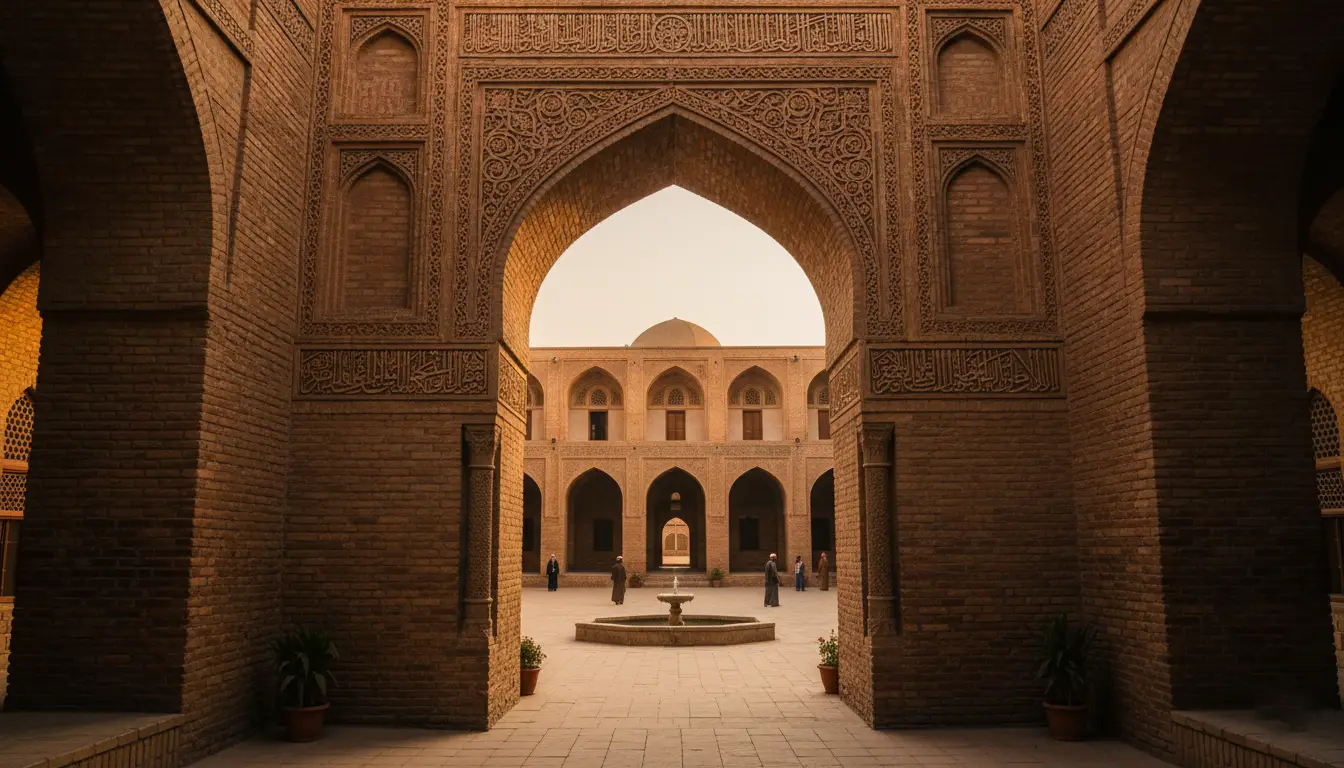
To stand in the courtyard of Baghdad’s Al-Kadhimiya Shrine, beneath the turquoise-tiled dome of Najaf’s Imam Ali Mosque, or before the restored arches of Mosul’s Al-Nuri Mosque, is to stand inside a prayer rendered in geometry.
Iraqi mosque architecture is not merely functional or ornamental. It is a visual theology — a sacred language encoded in star polygons, golden ratios, and interlocking circles — designed to lift the soul toward the infinite while anchoring it in cosmic order.
Rooted in ancient Mesopotamian metrology, refined by Abbasid-era mathematicians like the Banū Mūsā and Al-Kindī, and perfected by generations of anonymous artisans, this geometry serves a profound purpose:
To transform earthly space into a vessel for the transcendent.
This article explores the hidden patterns behind Iraq’s most spiritually resonant buildings — and how you, as a mindful traveller, can encounter them not just with your eyes, but with your heart.
For deeper context on planning such a journey, see our Complete Guide to Visiting Iraq, which covers everything from visas to spiritual etiquette.
Part I: The Origins — From Ziggurats to Mihrabs
Sacred geometry in Iraq did not begin with Islam.
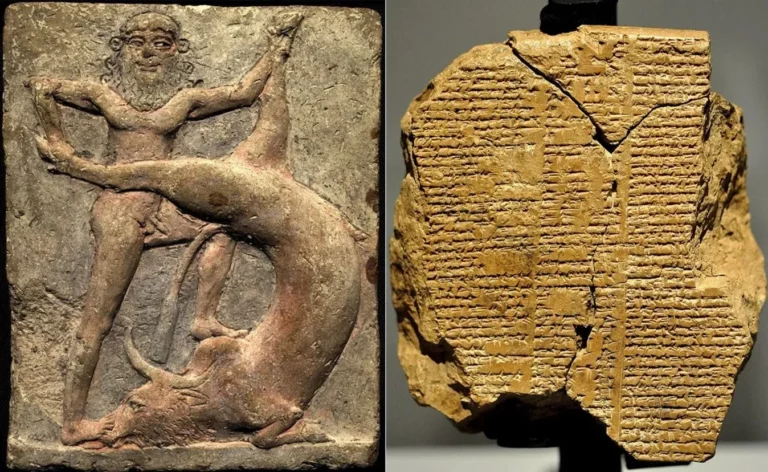
It began in Uruk, Ur, and Nineveh — where temple builders aligned structures with solstices and encoded cosmic cycles into brickwork. The Ziggurat of Ur (Explore here), for example, rises in seven terraces — echoing the seven celestial spheres of Babylonian cosmology.
When Islam arrived in the 7th century, it did not erase this legacy. It translated it.
- The circle — symbol of divine unity (tawḥīd) — became the basis for domes.
- The square — representing the four directions, the material world — grounded prayer halls.
- The octagon — transitional form between earth (square) and heaven (circle) — framed sacred thresholds.
In Iraqi mosques, this synthesis is especially potent. Unlike Ottoman or Persian styles, Iraqi architecture retains a Mesopotamian sobriety: fewer floral motifs, more structural clarity — where geometry is the ornament.
Fun fact: The word masjid (mosque) shares roots with sujūd (prostration) — and the prayer niche (miḥrāb) is often positioned so that the worshipper’s forehead aligns with the building’s geometric centre — a physical act of cosmic alignment.
Part II: The Language of Patterns — Decoding the Symbols
The Eight-Pointed Star (Khatim Sulayman — Seal of Solomon)
Where to see it:
- Tilework in Al-Kadhimiya Shrine, Baghdad
- Carved stucco in Al-Askari Shrine, Samarra
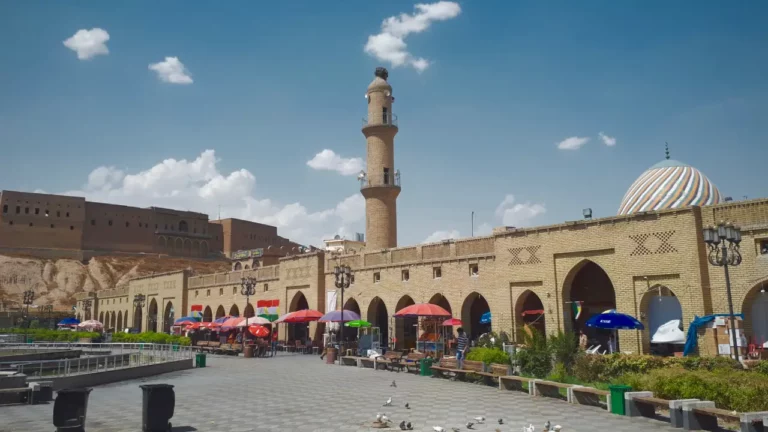
- Wooden minbar in Erbil’s Great Mosque
Symbolism:
- 8 = 4 (earthly directions) + 4 (cardinal virtues: justice, wisdom, courage, temperance)
- Also represents the 8 gates of Paradise in Islamic eschatology
- In Sufi tradition, the star’s interlaced lines signify the unity of opposites — light/dark, male/female, divine/human
Hidden maths: Often constructed using the “Circle of Unity” method — one circle, eight radii at 45° — a technique documented in 9th-century Baghdad manuscripts now held in the Iraq Museum.
The Infinite Interlace (Girih Straps)
Where to see it:
- Muqarnas (stalactite vaulting) in Najaf’s Imam Ali Shrine (Pilgrimage guide)
- Stone lattice in Karbala’s Abbas Shrine (Sacred city guide)
Symbolism:
- No beginning, no end — reflecting the eternal nature of God (al-Bāqī)
- The unbroken line mirrors the silsila (spiritual chain) of prophetic transmission
- Psychologically, the pattern induces meditative focus — guiding the eye inward
Technical mastery: Girih tiles (decagon, bowtie, rhombus) allow complex 5-fold symmetry — a mathematical feat once thought impossible before the 20th century. Iraqi artisans achieved it by the 12th century.
The Golden Rectangle & the Qibla Wall
Where to see it:
- Floor plan of Mosul’s Al-Tahera Church-turned-Mosque (post-restoration)
- Courtyard proportions of Basra’s Great Mosque (City guide)
Symbolism:
- The Golden Ratio (1:1.618) appears in nautilus shells, sunflowers — and Quranic calligraphy. Its use implies: “The same intelligence that orders nature orders this space.”
- In Iraqi mosques, the qibla wall (facing Mecca) is often the short side of a Golden Rectangle — drawing worshippers toward spiritual focus with subconscious harmony.
Part III: Case Studies — Geometry as Spiritual Practice
Al-Nuri Mosque, Mosul — The Leaning Minaret as Cosmic Axis
Though tragically damaged in 2017, the rebuilt Al-Hadba Minaret (A Day in Mosul’s Old City) retains its signature tilt — not a flaw, but a deliberate deviation.
- Why it leans: Local legend says it bowed in reverence toward Mecca.
- Geometric truth: The spiral staircase inside follows a Fibonacci sequence — each turn wider than the last, mirroring growth in nature. Climbing it becomes a kinetic meditation on ascension.
Today, the restored complex includes a Geometry Garden — where visitors walk a labyrinth based on the Rubʿ al-Ḥizb (۞), teaching unity through motion.
Imam Ali Shrine, Najaf — The Dome as Celestial Vault
The shrine’s iconic gilded dome is not just gold leaf — it’s a geodesic marvel.
- Diameter: 22m — divisible by 11 (number of Ahl al-Bayt Imams in Twelver Shi’a belief)
- 32 windows beneath the dome = 32 asbāb al-nuzūl (occasions of revelation)
- Interior calligraphy spirals upward in a logarithmic curve — echoing the expansion of the universe
At dawn, sunlight strikes a central muqarnas cell, casting a star-shaped beam onto the tomb — a daily theophany of light and number.
The Samarra Spiral Minaret — A Stairway to the Unseen
At the Great Mosque of Samarra, the Malwiya Tower isn’t a minaret for the call to prayer — it’s a cosmic diagram in brick.
- Height: 52m = 52 weeks in a solar year
- Spiral ramp: 1,196 steps — the numerical value (abjad) of “Yā Ḥayy Yā Qayyūm” (“O Living, O Self-Subsisting”)
- Climb it counter-clockwise (as pilgrims do), and each turn aligns with a zodiac sign — a journey from earth to sky
Pro Tip: Visit at sunset during spring equinox — when the shadow points due east, marking the axis of creation. Combine with a trip to nearby Nimrud or Nineveh (Compare Assyrian sites) to see how pre-Islamic sacred axes influenced Islamic orientation.
Part IV: The Artisans — Keepers of the Code
For centuries, Iraqi muhandisīn (master builders) passed down geometric knowledge orally — through apprenticeship, not textbooks.
- The Tulūʿ Method: Using only compass and straightedge, they constructed complex patterns from a single circle — reflecting the Quranic verse: “He is the First and the Last” (57:3).
- Women’s Role: In Mosul and Erbil, women wove girih-inspired patterns into mujaffa embroidery — turning sacred geometry into wearable devotion. Learn more in our guide to Iraq’s Art and Craft Scene.
Today, masters like Ustad Rafid (Baghdad) and Hajji Layla (Erbil) train youth in these techniques — ensuring the code survives.
“We don’t design. We discover,” says Ustad Rafid. “The pattern is already in the circle. Our job is to reveal it — like a sculptor freeing a figure from stone.”
Part V: Experiencing Sacred Geometry — A Traveller’s Guide
When to Visit
Geometry reveals itself best in light. Plan around:
- Spring equinox (March 20–21): Equal light/shadow — ideal for symmetry appreciation (Best Time to Visit Iraq)
- Ramadan evenings: Illuminated domes glow with mathematical precision during iftar
- Avoid midsummer: Harsh sun flattens depth; early mornings (5–8 AM) are golden
How to Look — A Mindful Practice
- Stand at the entrance — note the square courtyard (earth) opening to a circular dome (heaven)
- Trace a star pattern with your eyes — follow one line until it returns to start
- Listen: In domed spaces, whispers travel along geometric paths — a phenomenon called “whispering galleries”
- Sketch lightly (with permission) — even a rough circle-and-square helps internalise the harmony
Ethical Engagement
- Dress modestly — shoulders and knees covered (What to Wear in Iraq)
- Photograph only exteriors or with permission — interiors are sacred space
- Visit with a local guide — many understand the symbolism (First-Time Visitor Tips)
Recommended tour: Our Historical Sites You Can’t Miss package includes a Sacred Geometry Walk in Baghdad and Najaf.
Part VI: Why This Matters Today
In an age of algorithmic chaos and digital fragmentation, Iraqi sacred geometry offers an antidote: harmony by design.
These mosques remind us:
- Order is not oppression — it is the foundation of freedom
- Tradition is not stagnation — it is innovation rooted in meaning
- Beauty is not luxury — it is spiritual necessity
To witness a 12th-century muqarnas vault — where hundreds of cells fit perfectly without mortar — is to witness ‘adl (cosmic justice) made visible.
And in Iraq — a land scarred by division — that vision is profoundly healing.
Conclusion – The Circle Is Never Closed
Sacred geometry in Iraqi mosques is not a relic.
It is an invitation — to align, to reflect, to participate in a harmony older than nations.
As you stand beneath a dome in Najaf, trace a star in Samarra, or watch light fracture through Mosul’s restored arches, remember:
You are not just observing geometry.
You are inside it.
And in that moment — earth and heaven, human and divine, past and future — converge.
Just as the circle intended.
Plan Your Pilgrimage of Pattern
Ready to see these wonders firsthand? We’ve curated the perfect journey:
- 📅 Best season: Spring (Weather guide)
- ✈️ From the UK: Complete flight & visa guide
- 🛂 Visa help: How to obtain a tourist visa
- 💷 Budget wisely: Cost breakdown
- 📱 Stay connected: Top 5 travel apps for Iraq
- 🧭 Full itinerary: Complete Guide to Visiting Iraq
“God is Beautiful and loves beauty.”
— Hadith, often inscribed in the geometric bands of Iraqi mosques
Let that beauty guide your steps.
If you’re ready to explore Iraq, get in touch with us today. We offer complete travel packages, including flights, accommodation, and guided tours tailored to your needs. Simply fill out the form below or contact us on WhatsApp at +441992276061 for quick assistance. Let us make your journey to Iraq smooth and unforgettable!